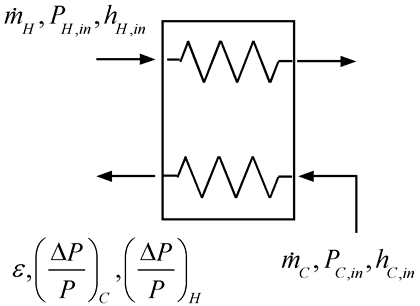
HeatExchanger5_CL
HeatExchanger5_CL models a counterflow heat exchanger with any type of fluids. The model divides the heat exchanger into sub heat exchangers in order to capture the impact of fluid heat capacity variation. HeatExchanger5_CL takes in the inlet conditions associated with the hot and cold flows and the effectiveness and returns the conductance and pinch point DT of the HX.
Inputs:
F_H$ = hot fluid
C_H =concentration if F_H$ is a brine; humidity ratio if F_H$ is AirH2O; otherwise enter 0
P_H_in = inlet pressure of hot fluid
h_H_in = enthalpy of hot fluid at inlet
m_dot_H = mass flow rate of hot fluid
F_C$ = cold fluid
C_C = concentration if F_C$ is a brine; humidity ratio if F_C$ is AirH2O; otherwise enter 0
P_C = inlet pressure of cold fluid
h_C_in = enthalpy of cold fluid at inlet
m_dot_C = mass flow rate of cold fluid
eff = effectiveness of heat exchanger
DPoverP_H = pressure drop normalized by inlet pressure on hot side
DPoverP_C = pressure drop normalized by inlet pressure on cold side
N = number of sub heat exchanger (if set to any value <1 then default of N = 10 is used)
Outputs:
h_H_out = enthalpy of hot fluid leaving
h_C_out = enthalpy of cold fluid leaving
UA = conductance of heat exchanger
DT_pp = pinchpoint temperature difference of heat exchanger
Note: This model will work with AirH2O, but it will not account for condensation. If condensation can occur, use a Condenser model.
Example:
$Load Component Library
$UnitSystem SI Mass J K Pa
$VarInfo h_C_in, h_C_out, h_H_in, h_H_out Units=J/kg
$VarInfo P_C_out, P_H_out units=Pa
$VarInfo T_H_Out, T_C_out Units=K AltUnits=C Guess=(T_H_in+T_C_in)/2
$VarInfo DT_pp Units=DELTAK
F_C$='EG'
C_C=25 [%]
P_C_in=200e3 [Pa]
T_C_in = ConvertTemp(C,K,20 [C])
h_C_in=Enthalpy(F_C$,P=P_C_in,T=T_C_in,C=C_C)
DPoverP_C = 0.01
m_dot_C = 0.25 [kg/s]
F_H$='Dowtherm_T'
P_H_in = 400e3 [Pa]
T_H_in = ConvertTemp(C,K,110 [C])
h_H_in = Enthalpy(F_H$,T=T_H_in, P=P_H_in)
C_H = 0
m_dot_H = 0.5 [kg/s]
DPoverP_H = 0.02
N = 10
eff = 0.5
CALL HeatExchanger5_CL(F_H$, C_H, P_H_in, h_H_in, m_dot_H, F_C$, C_C, P_C_in, h_C_in, m_dot_C, eff, DPoverP_H, DPoverP_C, N: h_H_out, h_C_out, UA, DT_pp)
P_H_out = P_H_in*(1-DPoverP_H)
h_H_out = Enthalpy(F_H$,T=T_H_out, P=P_H_out)
P_C_out = P_C_in*(1-DPoverP_C)
h_C_out=Enthalpy(F_C$,P=P_C_out,T=T_C_out,C=C_C)
{Solution:
UA = 932.8 [W/K]
DT_pp = 44.45 [K]
T_H_out = 342.6 [K] or 69.47 [C]
T_C_out = 338.7 [K] or 65.55 [C]}