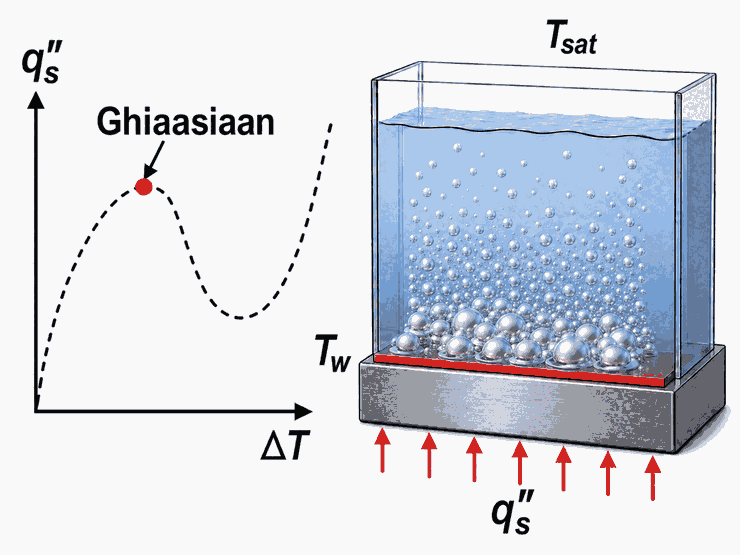
Critical_Heat_Flux_Gh
Critical_Heat_Flux_Gh returns the critical heat flux for the specified fluid and geometry using the information provided in Ghiaasiaan (2008). The correlation suggested by Sun and Lienhard (1970) is used to compute the critical heat flux and then corrections are applied for:
1. geometry based on work from Sun and Lienhard (1970), Ded and Lienhard (1972), and Lienhard and Dhir (1970).
2. contact angle based on Haramura (1999)
3. angle relative to horizontal based on Chang and You (1996)
4. liquid subcooling based on Elkassabgi and Lienhard (1988)
The calling protocol for the function is:
q`` = Critical_Heat_Flux_Gh(Fluid$, Geom$, L_char, T_sat, theta_r, theta, DT_sc)
Inputs:
Fluid$ - a string constant or variable containing the name of a fluid defined in the EES data base.
Geom$ - a string constant or variable that is one of the following: 'PLATE', 'CYLINDER', 'SPHERE', '1SIDEDRIBBON', '2SIDEDRIBBON', 'LARGE', or 'NONE'. 'NONE' indicates that no geometry correction will be applied. The ribbons are assumed to be vertical while the other surfaces are assumed to be oriented horizontally.
L_char - the characteristic length [m] or [ft] of the surface. For a sphere or cylinder, L_char is the radius. For a plate, L_char is the width or diameter if it is circular. For a ribbon, L_char is the height of the side. L_char is not used for 'LARGE', which should be used for a large but finite body. L_char is also not used for 'NONE'
T_sat - saturation temperature of the fluid in [C], [K], [F], or [R], depending on the setting for the EES unit system
theta_r - the receding contact angle [deg] or [rad]. If theta_r<0 then no correction is made for contact angle.
theta - the orientation of the body away from the reference orientation [deg] or [rad] - 0 indicates no change in orientation. If theta<0 then no correction is applied for angle.
DT_sc - the degree of liquid subcooling [C], [K], [F], or [R]. If DT_sc<=0 then no correction is made for subcooling.
Output:
Critical Heat Flux_Gh (i.e., the heat flux at the burnout point) [W/m^2] or [Btu/hr-ft^2]
Example:
$UnitSystem SI Mass J K Pa
$VarInfo q`` Units = 'W/m^2'
Fluid$ = 'Isobutane'
Geom$ = 'cylinder'
L_char = 0.01 [m]
T_sat = 290 [K]
theta_r = -999 [deg]
theta = 0 [deg]
DT_sc = 0 [K]
q`` = Critical_Heat_Flux_Gh(Fluid$,Geom$, L_char, T_sat, theta_r, theta, DT_sc)
{Solution:
q``= 332,942 [W/m^2]}