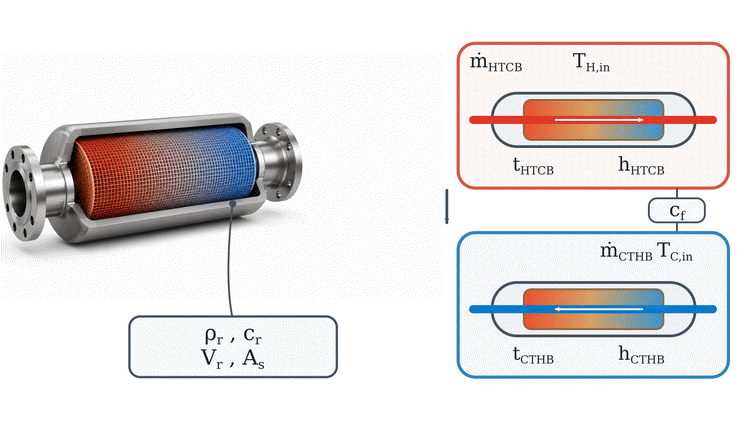
RegeneratorHX
SUBPROGRAM RegeneratorHX implements a general numerical solution for a regenerator as described in Section 8.10.5 of Nellis and Klein.
Inputs:
m_dot_HTCB hot-to-cold blow mass flow rate (kg/s)
T_H_in hot fluid inlet temperature (K or C)
m_dot_CTHB cold-to-hot blow mass flow rate (kg/s)
T_C_in cold fluid inlet temperature (K or C)
c_f specific heat capacity of the fluid (J/kg-K)
rho_r density of regenerator material (kg/m^3)
c_r specific heat capacity of regenerator material (J/kg-K)
t_HTCB time for hot-to-cold blow process (s)
t_CTHB time for cold-to-hot blow process (s)
h_HTCB heat xfer coefficient, hot-to-cold blow (W/m^2-K)
h_CTHB heat xfer coefficient, cold-to-hot blow (W/m^2-K)
V_r volume of regenerator material (m^3)
A_s total surface area for heat transfer (m^2)
Outputs:
Q heat transfer between hot and cold fluids (J/cycle)
T_H_out hot fluid outlet temperature (K or C)
T_C_out cold fluid outlet temperature (K or C)
Notes:
The numerical model uses 10 spatial nodes and 20 nodes in time for each blow process.
Example:
$UnitSystem SI K Pa J
$VarInfo Q units=J
$VarInfo T_C_out units=K
$VarInfo T_H_out units=K
m_dot_HTCB=0.221[kg/s] "hot-to-cold blow mass flow rate"
T_H_in=450 [K] "hot fluid inlet temperature"
m_dot_CTHB=0.121 [kg/s] "cold-to-hot blow mass flow rate"
T_C_in=310 [K] "cold fluid inlet temperature"
c_f=4230 [J/kg-K] "specific heat capacity of the fluid"
rho_r=7000 [kg/m^3] "density of regenerator material"
c_r=450 [J/kg-K] "specific heat capacity of regenerator material"
t_HTCB=22 [s] "time for hot-to-cold blow process"
t_CTHB=35 [s] "time for cold-to-hot blow process"
h_HTCB=400 [W/m^2-K] "heat xfer coefficient, hot-to-cold blow"
h_CTHB=252 [W/m^2-K] "heat xfer coefficient, cold-to-hot blow"
V_r=0.045 [m^3] "volume of regenerator material"
A_s=8.2 [m^2] "total surface area for heat transfer"
CALL RegeneratorHX(m_dot_HTCB, T_H_in, m_dot_CTHB, T_C_in, c_f, rho_r, c_r, t_HTCB, t_CTHB, h_HTCB, h_CTHB, V_r, A_s : Q, T_H_out, T_C_out)
{Solution:
Q=1.745E6 [J]
T_C_out=407.4 [K]
T_H_out=365.1 [K]}