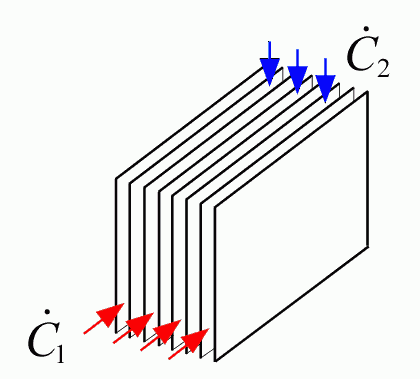
Cross Flow Both Mixed
The cross flow heat exchanger configuration requires that the two fluids flow perpendicular to each other. The mixed configuration indicates that the fluid can mix with itself across the width of the heat exchanger as it flows; practically, this means that the fluid cannot support a temperature gradient in the direction perpendicular to the flow direction. The effectiveness-NTU solution is available for cross flow heat exchangers where both fluids are mixed. Solution is from Nellis and Klein.
Note that the effectiveness is a non-monotonic function of NTU for this configuration and therefore there may be two values of NTU that yield a given effectiveness. In this case, the lower value of NTU is returned.
Example 1:
$UnitSystem SI Mass J K Pa
$VarInfo UA C_dot_1 C_dot_2 C_dot_min Units = 'W/K'
$VarInfo epsilon NTU Units = '-'
UA = 75 [W/K]
C_dot_1 = 50 [W/K]
C_dot_2 = 30 [W/K]
C_dot_min = Min(C_dot_1,C_dot_2)
NTU = UA/C_dot_min
epsilon=hx('crossflow_both_mixed', Ntu, C_dot_1, C_dot_2, 'epsilon')
{Solution:
epsilon = 0.6841}
Example 2:
$UnitSystem SI Mass J K Pa
$VarInfo UA C_dot_1 C_dot_2 C_dot_min Units = 'W/K'
$VarInfo epsilon NTU Units = '-'
C_dot_1 = 50 [W/K]
C_dot_2 = 30 [W/K]
epsilon = 0.61
NTU=hx('crossflow_both_mixed', epsilon, C_dot_1, C_dot_2, 'NTU')
C_dot_min = Min(C_dot_1,C_dot_2)
UA = NTU*C_dot_min
{Solution:
NTU = 1.478
UA = 44.33}