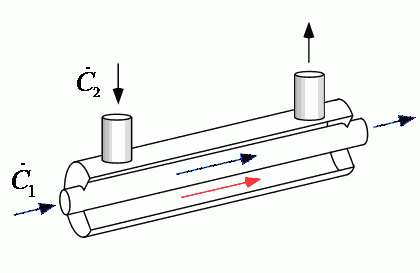
Parallel Flow Heat Exchanger
The parallel flow heat exchanger configuration requires that the two fluids flow in the same direction. The effectiveness-NTU and Log Mean Temperature Difference solutions are both available for parallel flow heat exchangers. Solution is from Nellis and Klein.
Example 1:
$UnitSystem SI Mass J K Pa
$VarInfo UA C_dot_1 C_dot_2 C_dot_min Units = 'W/K'
$VarInfo epsilon NTU Units = '-'
UA = 75 [W/K]
C_dot_1 = 50 [W/K]
C_dot_2 = 30 [W/K]
C_dot_min = Min(C_dot_1,C_dot_2)
NTU = UA/C_dot_min
epsilon=hx('parallelflow', Ntu, C_dot_1, C_dot_2, 'epsilon')
{Solution:
epsilon = 0.6136}
Example 2:
$UnitSystem SI Mass J K Pa
$VarInfo UA C_dot_1 C_dot_2 C_dot_min Units = 'W/K'
$VarInfo epsilon NTU Units = '-'
C_dot_1 = 50 [W/K]
C_dot_2 = 30 [W/K]
epsilon = 0.61
NTU=hx('parallelflow', epsilon, C_dot_1, C_dot_2, 'NTU')
C_dot_min = Min(C_dot_1,C_dot_2)
UA = NTU*C_dot_min
{Solution:
NTU = 2.331
UA = 69.93}